
The terms are often used interchangeably. They do not mean the same thing.
“Clean” and “Disinfected” Are Not Synonyms
A surface can look clean without being disinfected. A disinfectant can also be used incorrectly and fail to deliver the result someone expects.
In commercial facilities, the words cleaning, sanitizing, and disinfecting are often used as though they describe the same process. They do not.
Understanding the difference matters because each process has a different purpose—and the right choice depends on the surface, facility, situation, and applicable requirements.
1. Cleaning: Remove the Dirt
Cleaning physically removes dirt, soil, impurities, and many germs from surfaces. It typically involves water plus soap, detergent, or another appropriate cleaning product, along with mechanical action such as wiping or scrubbing.
According to the Centers for Disease Control and Prevention (CDC), regular cleaning alone is sufficient in many situations to reduce germs on surfaces in community facilities.
Cleaning is also an important first step before sanitizing or disinfecting because dirt and other impurities can interfere with the effectiveness of those processes.
CLEANING = PHYSICAL REMOVAL. It removes soil, dirt, and many germs from the surface.
2. Sanitizing: Reduce Germs to a Safer Level
Sanitizing reduces the number of germs remaining on a surface to levels considered safe under public-health codes or regulations.
The term is especially relevant in environments and applications where sanitation standards apply, including certain food-contact surfaces and childcare-related items. The exact product, process, and requirements depend on the setting.
As with disinfection, surfaces generally need to be cleaned first so the sanitizing process can work as intended.
SANITIZING = REDUCTION. It lowers the number of germs to a level considered safe under applicable standards.
3. Disinfecting: Kill Remaining Germs
Disinfecting uses a chemical product to kill harmful germs that remain on a surface after cleaning.
But simply spraying a product labeled “disinfectant” does not automatically mean a surface has been properly disinfected.
The product must be appropriate for the surface and intended use, and its label directions must be followed.
The Detail Many People Miss: Contact Time
One of the most important instructions on a disinfectant label is its contact time—sometimes called dwell time.
The U.S. Environmental Protection Agency (EPA) explains that contact time is the amount of time the product must remain on the surface to be effective. For many products, the surface must remain visibly wet for the entire specified contact time.
That means spraying disinfectants onto a surface and immediately wiping it dry may not meet the product’s directions for disinfection.
Different products—and sometimes different organisms listed on the same product label—can have different contact times. The label, not habit, should determine how the product is used.
More Chemical Is Not Necessarily More Clean
There can be a tendency to assume that disinfecting everything, all the time, is automatically better.
CDC guidance for community facilities takes a more targeted approach: clean high-touch surfaces regularly and other surfaces when visibly dirty; disinfect when circumstances warrant it, such as areas where someone has obviously been ill, or when specific facility requirements call for disinfection.
Healthcare facilities and other regulated environments can have different and more specific requirements, so their protocols should follow the rules and guidance applicable to those settings.
High-Touch Surfaces Deserve Attention
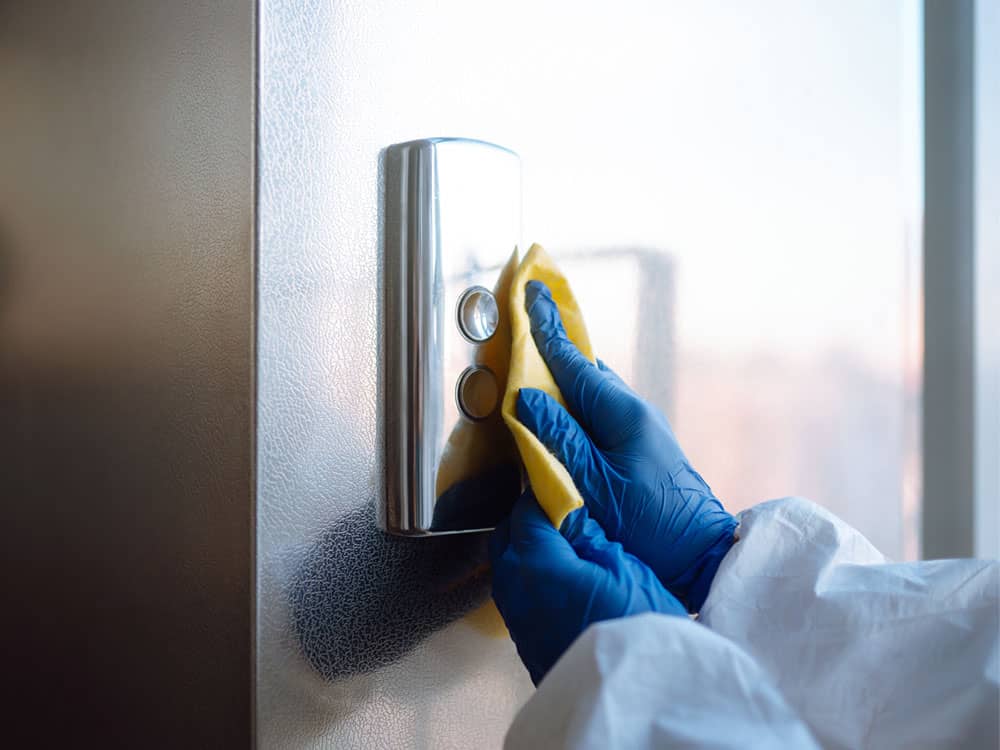
Door handles, restroom fixtures, elevator buttons, touchpads, counters, and other frequently touched surfaces can warrant more frequent attention because many people contact them throughout the day.
The appropriate process may include cleaning alone or cleaning followed by sanitizing or disinfecting, depending on the facility, circumstances, and applicable requirements.
The Product Has to Match the Job
Not every disinfectant is intended for every surface or every microorganism.
EPA-registered disinfectants include specific directions describing where and how the product may be used, how it should be applied, dilution requirements when applicable, and how long it must remain in contact with the surface.
Using a product outside its labeled directions can reduce effectiveness and may create unnecessary safety or surface-damage risks.
Professional cleaning therefore involves more than choosing a strong chemical. It requires choosing the right product and using it correctly.
What About Electrostatic Spraying and Fogging?
Application technology can be useful in specific circumstances, but the equipment itself does not make a product effective.
CDC guidance notes that fogging, fumigation, and wide-area or electrostatic spraying generally should not be used as primary surface-disinfection methods unless the disinfectant product label specifically permits that application method.
The same principle applies: follow the product label and use the method for which the product has been evaluated.
Cleaning Comes First
Perhaps the simplest lesson is also the most important: you generally cannot disinfect your way around a dirty surface.
Cleaning removes the soil and organic material that can interfere with disinfection. That is why professional protocols distinguish between removing dirt and applying an antimicrobial product for a specific purpose.
They are related steps, but they are not interchangeable.
Questions to Ask Your Commercial Cleaning Company
- Which surfaces are being cleaned versus sanitized or disinfected?
- Are disinfectants EPA-registered for their intended use?
- Are products appropriate for the surfaces on which they are being used?
- Does the cleaning team follow the product’s dilution and contact-time instructions?
- Are high-touch areas identified in the scope of work?
- Does our type of facility have specific cleaning or disinfection requirements?
The Right Process for the Right Situation
A professional cleaning program should not treat “clean,” “sanitize,” and “disinfect” as interchangeable marketing words.
Cleaning removes. Sanitizing reduces. Disinfecting kills remaining germs when performed correctly with an appropriate product.
Knowing the difference helps businesses ask better questions, use products more responsibly, and build cleaning protocols that fit the actual facility.
You focus on your business. We focus on cleaning.
Mint Condition DFW provides commercial cleaning services throughout the Dallas-Fort Worth area. We work with businesses to develop cleaning programs based on the facility, its surfaces, traffic, and operational needs. Facilities subject to industry-specific regulations should follow the requirements applicable to their setting.