
Routine Cleaning Isn’t Always Enough to Maintain Commercial Floors
Your cleaning crew vacuumed the floor.
They damp-mopped it.
So why does it still look dull, dingy or dirty?
It’s a frustration we hear from businesses, particularly those with high-traffic facilities.
The answer isn’t always that the floor wasn’t cleaned properly.
Sometimes the cleaning method simply isn’t enough for what the floor needs.
Routine vacuuming, dust mopping and damp mopping play an important role in commercial floor maintenance. They remove loose soil, debris and everyday surface dirt.
But commercial floors take a beating.
Employees, customers, children, carts, deliveries and outside soil repeatedly travel across the same pathways. Entrances, hallways, restrooms, breakrooms and other high-traffic areas typically show the effects first.
Over time, routine cleaning may no longer restore the appearance a facility manager expects.
That’s when it’s important to understand the difference between routine cleaning, periodic deep cleaning and restorative floor care.
Level 1: Routine Maintenance — Vacuuming, Dust Mopping and Damp Mopping
Think of this as the foundation of commercial floor care.
Depending on the flooring, manufacturer recommendations and facility conditions, routine maintenance can include:
- Vacuuming, sweeping or dust mopping to remove loose dirt and grit
- Damp or wet mopping with an appropriate cleaner
- Promptly addressing spills
- Cleaning entrances and high-traffic areas more frequently
- Maintaining entrance mats that help reduce the amount of outside soil entering the facility
Removing loose grit is particularly important because abrasive particles carried through a building can contribute to scratching and visible wear.
Routine cleaning should therefore happen consistently.
But there’s an important limitation:
A mop isn’t a floor-restoration tool.
As soil, residue, scuffs and wear accumulate, a floor may eventually need something more.
Level 2: Periodic Deep Cleaning — Scrubbing
This is the step many businesses overlook.
Periodic scrubbing uses mechanical agitation—or appropriate manual scrubbing in smaller areas—to provide deeper cleaning than routine damp mopping.
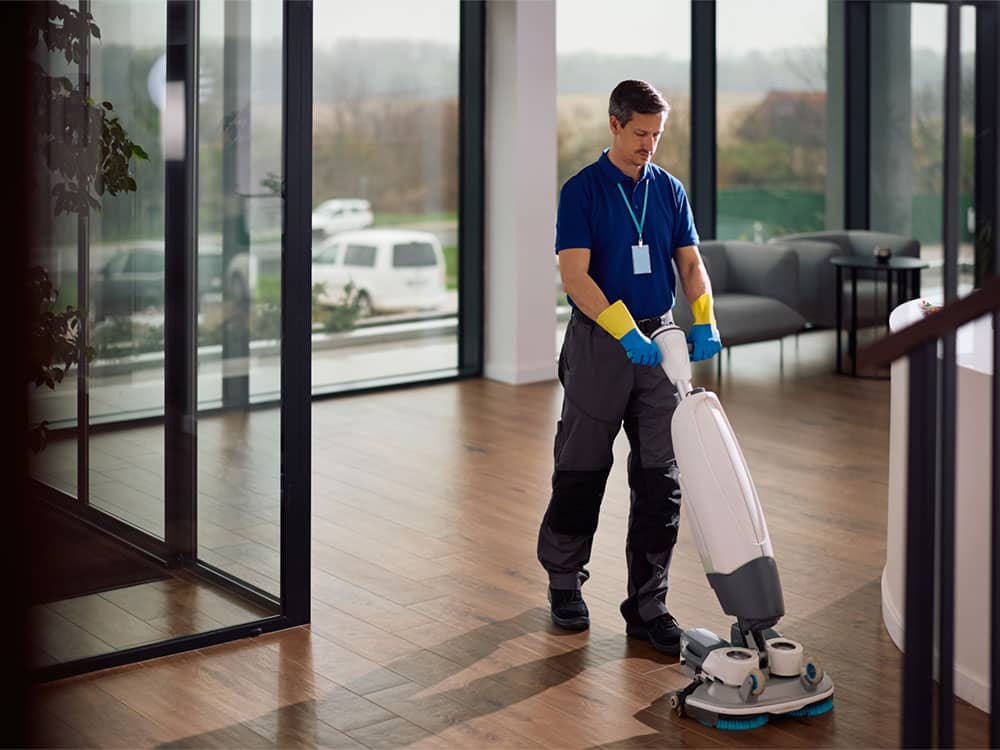
Depending on the floor, this might involve an automatic scrubber, a rotary machine or another manufacturer-approved system using the correct pad, brush and cleaning solution.
Why does this make a difference?
A mop primarily moves cleaning solution across the surface and collects soil.
A scrubber adds agitation.
That mechanical action can loosen embedded or adhered soil that routine mopping may leave behind.
For high-traffic facilities, periodic scrubbing can make a significant difference in floor appearance without automatically moving to a full restorative treatment.
How frequently should it be done?
There isn’t one schedule that works for every facility.
Traffic, flooring type, soil levels, entrances, weather, maintenance history and manufacturer recommendations all matter.
The floor should help determine the schedule.
Level 3: Restorative Maintenance — When the Floor Finish Needs More Than Cleaning
This is where knowing what type of floor you have becomes essential.
Traditional commercial vinyl composition tile—commonly called VCT—often uses a protective floor-finish or polish system.
Over time, that finish can become scratched, worn or embedded with soil.
VCT maintenance can therefore include periodic scrubbing and recoating, burnishing or buffing, and eventually stripping the worn finish and applying new floor finish when restorative maintenance is warranted.
This is what many people commonly call “strip and wax.”
But it should not be treated as a universal maintenance procedure for every vinyl floor.
VCT, LVT and LVP Are Not the Same Floor
This distinction matters.
VCT — Vinyl Composition Tile has been widely used in commercial facilities for decades. Traditional VCT commonly relies on a floor-finish system for protection, appearance and long-term maintenance.
LVT — Luxury Vinyl Tile and LVP — Luxury Vinyl Plank are different products.
Many newer commercial LVT and LVP products have durable factory-applied wear layers or coatings and may be designed for no-polish or polish-optional maintenance.
That means automatically stripping and waxing an LVT or LVP floor simply because it is “vinyl” can be the wrong approach.
The correct maintenance program should follow the flooring manufacturer’s recommendations.
Before treating the floor, identify the floor.
Does Every VCT Floor Need to Be Stripped and Refinished Every 6–9 Months?
Not necessarily.
This is another area where a universal rule can create the wrong expectation.
High-traffic VCT may require more frequent restorative attention than lightly used areas, but stripping should not simply happen because a calendar says six or nine months have passed.
Manufacturers generally recommend a maintenance program that protects the finish and renews it as conditions require.
In some cases, periodic scrubbing, recoating and burnishing can restore appearance and extend the life of the existing finish without requiring a complete strip.
Eventually, however, when the finish is badly worn, damaged or no longer responding adequately to interim maintenance, stripping and refinishing may be appropriate.
The objective isn’t to strip a floor as often as possible.
It’s to maintain the protective finish so the underlying floor lasts and looks its best.
Why High-Traffic Areas Need More Attention
Walk through almost any commercial facility and you’ll see predictable traffic patterns.
Entrances.
Main hallways.
Areas in front of elevators.
Restrooms.
Breakrooms.
Reception areas.
Classrooms and learning spaces.
Those areas can deteriorate visually much faster than low-traffic offices or storage spaces.
That means an effective floor-care program doesn’t necessarily treat every square foot identically.
A facility may need routine cleaning everywhere, more frequent scrubbing in high-traffic zones and restorative maintenance only where conditions warrant it.
That’s a more thoughtful—and often more economical—approach than waiting until the entire floor looks bad.
Your Entrance Is Part of Your Floor-Care Program
Some of the most effective floor maintenance happens before the dirt reaches the floor.
Commercial flooring manufacturers emphasize properly maintained entrance matting because it captures dirt, grit and moisture that would otherwise be tracked farther into the building.
That matters because every particle stopped at the entrance is one less abrasive particle traveling across the floor.
Floor care isn’t simply about removing dirt.
It’s also about preventing as much of it as possible from entering the facility in the first place.
So Why Does My Floor Still Look Dirty?
If your floors are being vacuumed and damp-mopped regularly but still look dull or dirty, don’t immediately assume your cleaning crew isn’t doing its job.
Ask a few additional questions:
- What type of flooring do we actually have?
- What does the manufacturer recommend for maintaining it?
- When was the floor last deep-scrubbed?
- If it’s VCT, what condition is the protective finish in?
- Are high-traffic areas receiving enough attention?
- Are entrance mats capturing enough outside soil?
- Does the floor need cleaning—or does it need restoration?
Those are two very different problems.
The Right Floor Care Starts With the Right Diagnosis
At Mint Condition DFW, we believe floor care should be based on the flooring material, the condition of the floor, traffic patterns and the needs of the facility—not a one-size-fits-all schedule.
For one facility, routine vacuuming and damp mopping may be sufficient.
Another may benefit from periodic machine scrubbing.
A traditional VCT floor may eventually require scrub-and-recoat or full restorative stripping and refinishing.
A modern LVT floor may require an entirely different maintenance approach.
The objective is the same:
Use the right maintenance at the right time for the right floor.
Because durable flooring isn’t the same thing as maintenance-free flooring.
You focus on your business. We focus on cleaning.
Mint Condition DFW provides commercial cleaning and floor-care services throughout the Dallas-Fort Worth area. If your floors remain dull or dirty despite routine cleaning, we can help evaluate their condition and determine whether your facility needs routine cleaning, periodic deep cleaning or restorative floor care.