
 What if you had a dollar for every time you heard the word “tariff” this year?
You likely could retire.
Not all business models are created equal when it comes to economic resilience. Even many service-based businesses that may not be affected by tariffs directly will still feel the pain further down the line. Case in point: recent analysis shows that U.S. factories are seeing an overall increase in costs of 2% to 4.5% from tariffs. Naturally, businesses need to start pivoting the business or cutting costs elsewhere. H.R. or finance departments begin to shrink or outsource to consultants. Advertising and marketing budgets get slashed.
However, businesses that provide essential services and that were largely unaffected during the COVID-19 pandemic (such as cleaning, internet, electricity, etc.) continue to thrive despite economic uncertainty.
For business executives who are looking for a new chapter – without the word “tariff” anywhere near their top-ten of daily worries, owning a Master Franchise could be that guiding light.
Burnout is Real
I am an executive leader with years of experience and I am burned out from my job. What can I do instead?
The trickle-down effect of tariffs is only fueling an already strained workforce. From managing a higher overhead (brick-and-mortar, technology costs, etc.), operating on much smaller margins, as well as finding the right people for the right roles, it’s no wonder burnout is sweeping many leadership roles with 60% of executives citing it as the primary reason they leave their jobs.
For many, they may simply trade one fire for another, often without many options if tariffs impact much of their industry. And while any business has risk, a business model that has survived thirty years of technology advances, the 2008 recession, and one pandemic is historically – if not factually – stronger than most models.
Invest in an Essential Businesses
What are the key characteristics of a business investment that is resistant to tariffs and economic uncertainty?
Working in a completely U.S.-based and U.S.-dependent business that is also essential?
Seems too good to be true.
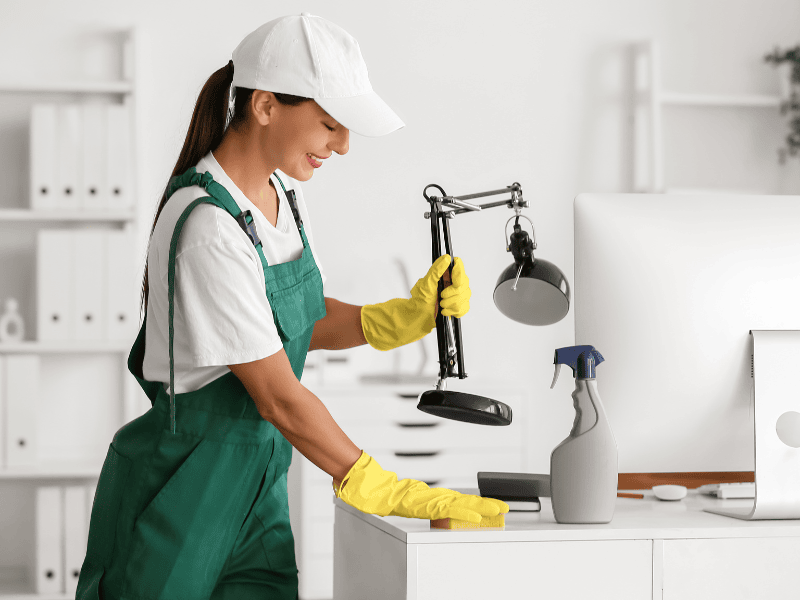
Service-first business models that operate with low overhead and rely mostly on U.S. products are – at face value – resistant to being directly impacted by tariffs. Doctor’s offices, public-facing organizations, and manufacturing plants all require a clean and sanitary workspace. Therefore, a cleaning service is essential despite any swings of the economy.
It is possible to start a new career chapter where the word “tariff” is just a passing headline. If you are planning to research a business investment in, consider these three questions.
- What are the overhead costs of managing a Master Franchise?
Any business investment is, well, an investment, but consider the ongoing costs of running that business. Does it require a brick-and-mortar? What is the overall cost of supplies, and can you expect that cost to rise naturally with inflation (versus being inconsistent or unknowable with tariffs)? Look for investments that use as many U.S.-based products as possible and that rely on a service versus a product (which requires a brick-and-mortar and inventory).
- Is commercial cleaning a relevant industry when more businesses are hybrid or offer “work from home” benefits?
First, the reality is that back-to-office rates have recently hit a 5-year-high with 75% of companies surveyed met their attendance goals in 2025. Work from home flexibility is often seen as a surprise perk in many industries versus “the norm,” that it was in 2020.
Second, there are a lot of businesses that will never be able to operate on a hybrid or a fully remote schedule. These essential businesses include doctors’ offices, dentists, manufacturers, shipping warehouses, and more. Many industries – if not most – require people to have boots on the ground in order to keep business moving forward.
- Is it possible to grow the business even during economic uncertainty?
Some business investments are harder to scale than others. If a business has a reliance on international products or requires a brick-and-mortar and shelves stocked with inventory is typically a difficult business to grow if people aren’t spending money. This is especially true if the business is more of a pastime or hobby (like eating out, or buying a new guitar). In a recent report from PBS, tariffs would cause the average household to have $2,400 less than it would have otherwise. That’s no small number. And to make up for that deficit, families will be more critical of where they spend their money in their communities.
While most of the business world is exhausted by the conversations around tariffs, as well as their inability to control how it affects their industry, some businesses have remained, dare we say, tariff-resistant. The good news: some of those businesses are the perfect investment for executive-level leaders who are ready for a new chapter. And – bonus – if a business thrives when times are tough, just imagine what this new career path could look like when the economy bounces back.
Want to know more about Mint Condition’s Master Franchises? You can set up a free consultation with our Director of Master Franchise Development, Randy, today. Call him at: (803) 548-6121 ext. 113